
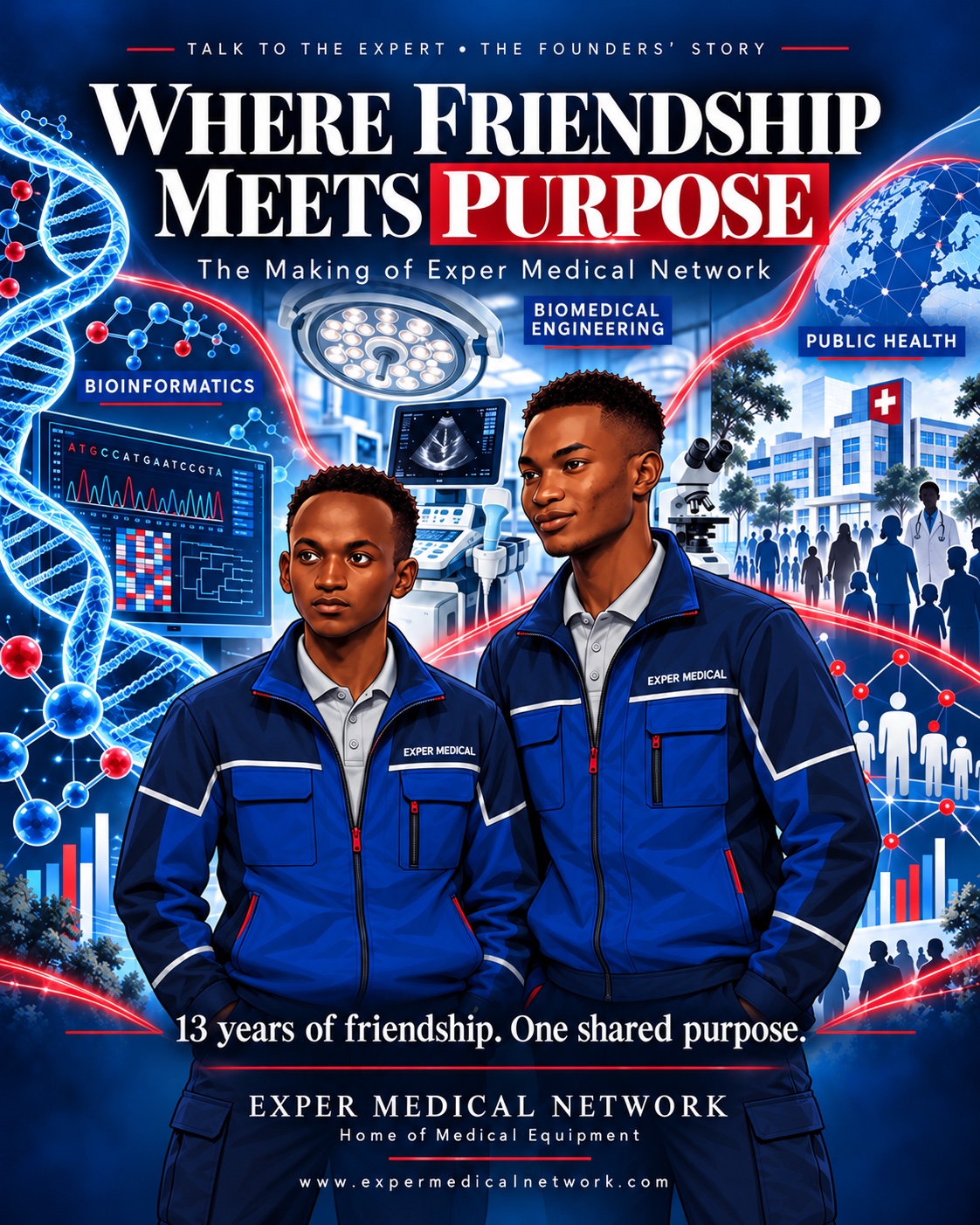
Chapter 1: In 2013, We Were Schoolmates—Not Business Partners
When I met Drake in 2013 at St Mary’s Kitende, I did not know that our friendship would eventually help lay the foundation for Exper Medical Network.
There was no company presentation. No procurement strategy. No five-year financial projection.
We were secondary school students.
At that stage, understanding the next examination was a more immediate priority than understanding a medical equipment supply chain.
Looking back, that is what makes the story special. Before there was a business relationship, there was a human relationship. We had the opportunity to know each other before professional titles, commercial responsibilities and customer expectations entered the picture.
A friendship that began at school would grow through university, professional development and an increasingly serious interest in healthcare technology.
More than thirteen years later, we are building something that neither of us could have fully imagined in 2013.
Apparently, some school friendships come with a very long-term business development plan. You simply do not receive the document on the first day.
Chapter 2: Makerere Gave Our Friendship an Engineering Language
We both went on to study a Bachelor of Science in Biomedical Engineering at Makerere University.
Our friendship now had another dimension: a shared technical foundation.
Biomedical engineering sits at the intersection of engineering and healthcare. It demands an understanding of how technology works—and an appreciation of the clinical environment in which it must work.
Suddenly, there was a new vocabulary around us: instrumentation, sensors, signal processing, electronics, biomechanics and physiological measurements.
But the most important idea was not a technical term.
It was responsibility.
A medical device is not simply an interesting collection of components. Its intended purpose connects it to a healthcare worker’s decisions and a patient’s care.
That makes the engineering questions more demanding.
Does it function correctly? Is it appropriate for its intended use? Can its performance be verified? Can the people expected to operate it do so confidently?
Engineering also teaches humility.
You can be very confident about a circuit until the circuit politely refuses to recognise your confidence.
Chapter 3: The Same Foundation, Different Professional Lenses
Our journeys gave us complementary perspectives.
Drake has worked with international NGOs, private hospitals and a medical engineering company. His experience spans different organisational environments, each with its own priorities and operational constraints.
He also holds an MSc in Public Health.
I hold an MSc in Bioinformatics, alongside my biomedical engineering background.
These disciplines do not make us interchangeable. They make our conversations more useful.
Public health encourages attention to population needs, service delivery, access and the wider systems surrounding healthcare.
Bioinformatics brings a strong interest in data, analytical reasoning and extracting meaningful information from complex biological questions.
Biomedical engineering provides our common technical language.
Together, those perspectives encourage us to examine a proposal from more than one direction: the equipment, the people, the information and the service it is meant to support.
One of us can keep pulling the discussion towards technical detail. The other can bring it back to the bigger healthcare question.
Occasionally, the equipment specification needs a meeting.
Occasionally, the engineers discussing it need one.
Chapter 4: The First Big Brainstorm—What Problem Are We Actually Solving?
The thinking behind Exper Medical Network can be expressed through a series of questions.
The first is deceptively simple:
Are we helping a facility buy a machine—or helping it establish a functioning service?
Those are not always the same thing.
A request for a laboratory analyzer begins with an equipment name. A useful procurement discussion goes further.
What tests does the laboratory intend to offer? What workload is anticipated? What consumables will be needed? Who will operate the system? What support will be available?
The same reasoning applies across departments.
An operating theatre is not just an operating table. A laboratory is not just an analyzer. A ward is not just a collection of beds.
Each is an operational environment.
Our ambition became clearer when we looked beyond individual products and towards the decisions connecting them.
The commercial question is, What does the customer want to purchase?
The engineering question is, What must be in place for that purchase to be useful?
A responsible equipment business must take both seriously.
Chapter 5: The Second Brainstorm—The Price Tag Is Only the Beginning
Another important question follows:
What will this equipment require throughout its working life?
This is where the discussion moves from purchase price to total cost of ownership.
A quotation may show the cost of acquiring a device. A buying decision also needs to consider the associated costs: installation, accessories, consumables, training, maintenance and eventual replacement.
Not every category applies in the same way to every device. That is precisely why careful comparison matters.
For a laboratory system, we might frame the discussion around reagent requirements, quality-control materials and service arrangements.
For an electrically powered device, we would want the relevant power and installation requirements clearly documented.
For any equipment purchase, we want to understand what is included—and what is not.
The smallest quotation is not automatically the best value.
Equally, the most expensive quotation does not automatically represent the best engineering decision.
There is no technical specification called “expensive, therefore suitable.”
If there were, procurement meetings would be much shorter.
Chapter 6: The Third Brainstorm—A Supply Chain Must Carry More Than Boxes
When people hear “medical equipment supply chain,” they may picture sourcing, shipping and delivery.
Those activities matter. But our ambition is to build relationships that also carry information, accountability and technical understanding.
A useful procurement process connects several stages:
Needs assessment → specification → supplier evaluation → delivery planning → acceptance → ongoing support.
At each stage, there are questions worth asking.
Does the proposed specification reflect the intended clinical work?
Are accessories and consumables clearly identified?
What documentation should accompany the equipment?
Who is responsible for installation where it is required?
How will the facility check that the delivered item matches the order?
What happens if a fault is reported?
This is the thinking behind equipment lifecycle management: considering the equipment beyond the moment of sale.
A delivery note is an important document.
It is not, by itself, evidence that a department is ready to use everything delivered.
Our aspiration is to help close that gap between receiving equipment and being ready to put it to work.
Chapter 7: The Fourth Brainstorm—How Do We Make Technical Knowledge Useful?
Technical knowledge has little value to a customer if we cannot communicate it clearly.
A hospital administrator should not need to become a biomedical engineer to understand an equipment proposal.
A clinician should not have to decode vague sales language to determine whether an accessory is included.
A procurement officer should be able to distinguish a confirmed specification from an assumption.
That means translating technical concepts into practical questions.
Instead of merely saying “serviceability,” we can ask: Can this equipment be maintained, and what support arrangements are available?
Instead of saying “infrastructure compatibility,” we can ask: What does the room need before the equipment arrives?
Instead of saying “acceptance criteria,” we can ask: What will we check before the facility accepts the delivery?
Clear communication does not weaken engineering. It makes engineering usable.
A good explanation should leave the customer better informed—not impressed but confused.
If somebody finishes our conversation thinking, “That sounded very intelligent, but I still do not know what I am buying,” we have more work to do.
Chapter 8: Friendship Is an Advantage—But It Is Not a Business Procedure
A long friendship gives a partnership history.
It does not remove the need for structure.
Building a company requires clear responsibilities, documented decisions, financial discipline and the ability to discuss difficult issues without turning every disagreement into a personal matter.
That is an important distinction.
A friend can understand what you meant.
A purchase order needs to state what you meant.
A friend might remember a conversation.
A business needs a record.
Our complementary backgrounds give us different ways of examining a decision. The objective is not to make those differences disappear. It is to use them constructively.
A proposal becomes stronger when it survives thoughtful questions.
Is the recommendation technically appropriate? Is it commercially realistic? Are the commitments clear? Can the customer understand the limitations as well as the benefits?
Friendship helps open the conversation.
Professional discipline helps finish it properly.
And no, “but we have known each other since Kitende” is not an accounting system.
Chapter 9: From Shared Thinking to Exper Medical Network
Exper Medical Network grew from the coming together of our friendship, education, professional experience and ambition.
For me, the most meaningful part is not simply that two friends became co-founders.
It is that our relationship developed into a platform for applying what we had learned.
We wanted to build a medical equipment business with a strong technical identity: one that takes equipment selection seriously and recognises the practical realities facing healthcare facilities.
That ambition requires balance.
Clinical needs matter. So do budgets.
Technical specifications matter. So does the availability of the people and resources needed to use the equipment.
Commercial growth matters. So does the credibility of the advice behind each recommendation.
Our goal is to build one of Uganda’s finest medical equipment supply networks.
That is an ambition we must earn through our work—not a title we can award ourselves.
It means continuing to learn, communicating honestly and treating trust as something that must be renewed with every customer interaction.
A strong brand should be more than a good-looking logo on a quotation.
Although, as entrepreneurs, we would still like the logo to look excellent.
Chapter 10: The Friendship Was the Beginning. The Responsibility Is the Future.
When I think about Drake and our journey, I see more than a business partnership.
I see a friendship that began in 2013 at St Mary’s Kitende.
I see two students who went on to study biomedical engineering at Makerere University.
I see professional paths that expanded our understanding of healthcare, followed by postgraduate study that gave each of us a different analytical lens.
And I see those experiences coming together in Exper Medical Network.
Our story is still being written.
There is more to learn, more to improve and more to build. The ambition is not merely to supply more equipment. It is to contribute to better-informed equipment decisions and stronger relationships between technology and the people who depend on it.
That is the real connection between friendship and engineering in our story.
Friendship gave us a foundation.
Education gave us a language.
Experience gave us perspective.
Building a company gave us a shared responsibility.
In 2013, I met a schoolmate.
Today, I work alongside a co-founder with whom I share more than thirteen years of history—and a belief that medical equipment supply should be supported by serious thinking.
We are still asking questions.
Still comparing ideas.
Still finding reasons to laugh.
The difference is that our brainstorming now comes with specifications, quotations and considerably more responsibility.
Before the machines, there was a friendship. Behind Exper Medical Network, there is a shared purpose.
Exper Medical Network — Home of Medical Equipment.
About the founders
Kyagulanyi Ally (Movich) is a biomedical engineer, holds an MSc in Bioinformatics, and is a co-founder of Exper Medical Network.
Drake Amutuheire is a biomedical engineer, holds an MSc in Public Health, and is a co-founder of Exper Medical Network. His professional experience includes work with international NGOs, private hospitals and a medical engineering company.
Both studied BSc Biomedical Engineering at Makerere University after meeting at St Mary’s Kitende in 2013.
The brainstorming sections present the founding philosophy in narrative form, rather than as verbatim records of specific conversations.
Start a conversation with Exper
Explore our medical equipment supply enquiries or contact Exper Medical Network on +256 756 789 821 and info.brandexper@gmail.com.