
Everyone Sees the Machine. I See the Responsibility.
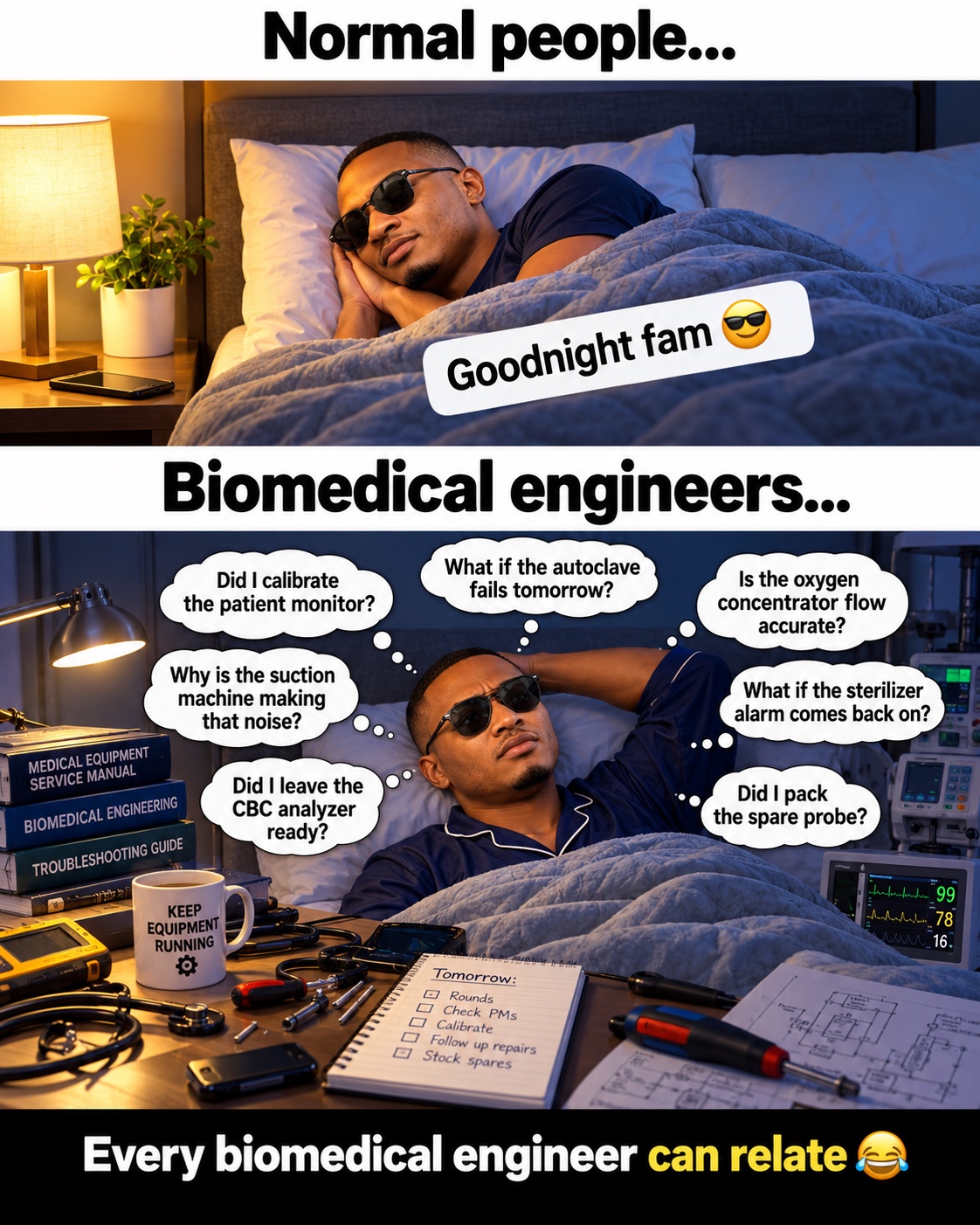
Have you ever gone to bed, closed your eyes, and suddenly remembered a machine you repaired three days ago?
Did I tighten that connection properly?
Was that patient monitor giving accurate readings?
What if the autoclave develops another fault tomorrow?
Did I really fix that CBC analyzer, or did I just convince it to behave for a few hours? 😂
Welcome to my life as a biomedical engineer.
While most people worry about what to wear tomorrow, I sometimes find myself mentally troubleshooting machines that are kilometres away from my bedroom.
And the funniest part?
The machine is probably sleeping peacefully. I’m the one losing sleep. 😂
But behind these funny experiences is a profession that has shaped my life, challenged my thinking, introduced me to incredible people, and ultimately inspired me to build something bigger than myself.
This is my story.
Chapter 1: How I Fell in Love With Machines That Save Lives
My journey into biomedical engineering wasn’t simply about choosing a career.
It was about discovering a fascinating meeting point between engineering and medicine.
I was intrigued by a simple question:
How can a collection of wires, sensors, circuits, software, pumps, and mechanical components become a machine that helps save someone’s life?
Think about it.
An ultrasound scanner allows a mother to see her unborn baby.
A patient monitor follows the vital signs of someone fighting for their life.
An anesthesia machine helps make complicated surgical procedures possible.
A laboratory analyzer transforms a small blood sample into valuable clinical information.
To the ordinary person, these are medical machines.
To me, they represent the extraordinary possibilities of engineering.
My engineering education provided the scientific foundation, but my practical experience taught me something no textbook could fully explain:
In a hospital, engineering decisions have human consequences.
And that changed the way I looked at my profession.
Chapter 2: The Hospital Became My Second Classroom
Over the years, I’ve accumulated approximately a decade of experience in biomedical engineering and medical technology, including five years of hospital-based experience.
Working around hospitals taught me patience, precision, humility, and the importance of solving problems under pressure.
In a hospital, a faulty machine is not always just another maintenance job.
Sometimes a surgeon is waiting.
Sometimes a laboratory has patients waiting for results.
Sometimes nurses are desperately trying to keep their department running.
And sometimes someone approaches you with the sentence every biomedical engineer knows too well:
“Engineer, the machine was working yesterday!” 😭
I have always found that statement funny.
Of course it was working yesterday!
If it had stopped working yesterday, perhaps you would have called me yesterday! 😂
But the laughter disappears when you realize that everyone is depending on you to find a solution.
That is when engineering becomes more than a technical job.
It becomes a responsibility.
Chapter 3: The Machines That Test Your Patience
Every biomedical engineer has encountered a machine that seems determined to embarrass them.
You arrive at the hospital.
The staff explain that the equipment has not been working all morning.
You inspect the machine.
You switch it on.
And suddenly…
IT WORKS PERFECTLY. 😂
Everyone looks at you.
You look at the machine.
The machine looks innocent.
You haven’t even touched a screwdriver.
Then someone says:
“Engineer, maybe it fears you.”
I wish all biomedical problems were that easy!
Unfortunately, the more interesting faults are the ones that disappear when you’re troubleshooting and return immediately after you’ve left.
A laboratory analyzer can report a pressure problem even when the obvious components appear fine.
An autoclave can heat normally one day and produce an unfamiliar alarm the next.
A ventilator can behave differently under different test conditions.
A patient monitor can display perfectly normal numbers while its measurements still require proper verification.
These experiences taught me never to confuse a machine that switches on with a machine that is functioning correctly.
One of my most important lessons: A medical machine is not safe merely because its display lights up.
It must be tested, verified, maintained, and evaluated against its intended clinical purpose.
Chapter 4: Biomedical Engineers Are Professional Overthinkers
Sometimes I believe biomedical engineering should come with a warning label:
CAUTION: This profession may cause excessive thinking, spontaneous troubleshooting, and the inability to ignore unusual mechanical sounds.
Imagine sitting in a restaurant.
Everyone is enjoying the music.
But somewhere in the background, you hear a strange repetitive sound.
Your brain immediately starts investigating.
Is that a loose bearing?
Is something vibrating?
Could it be a failing motor?
My friend, you’re supposed to be eating chicken! 😂
Even worse, we develop the habit of examining medical equipment everywhere we go.
Visit a hospital as a patient?
You start noticing the equipment models.
Walk into a laboratory?
You immediately recognize the analyzers.
Enter an operating theatre?
Your eyes move from the operating table to the anesthesia machine, surgical lights, suction equipment, and patient monitor.
Sometimes I think biomedical engineers don’t visit hospitals.
We conduct unpaid equipment inspections with our eyes. 😂
Chapter 5: From Repairing Medical Equipment to Building Exper Medical Network
As my experience grew, I began to see another side of healthcare engineering.
I realized that many healthcare facilities face challenges long before their machines break down.
Some buy equipment that does not match their clinical needs.
Others invest in devices without considering maintenance costs, availability of spare parts, staff training, installation requirements, or technical support.
Sometimes a hospital buys an expensive machine but lacks the infrastructure to use it effectively.
That observation helped shape my entrepreneurial journey.
Together with my co-founder, Drake Amutuheire, I helped establish Exper Medical Network, a company committed to improving access to medical equipment and technical expertise.
Our vision was bigger than selling machines.
We wanted to help healthcare providers make better equipment decisions.
Through Exper Medical Network, my responsibilities expanded beyond engineering into business development, equipment sourcing, customer relationships, technical consultancy, and healthcare project planning.
It has not always been an easy transition.
As an engineer, you may understand why a particular machine is better for a hospital.
As an entrepreneur, you must also understand why the customer may not be able to afford it.
You learn to balance technical quality, financial realities, reliability, long-term serviceability, and customer expectations.
And you discover that business has its own alarms.
The most frightening one?
“Engineer, can you reduce the price?” 😂
Sometimes a client wants a brand-new ultrasound scanner, premium features, several probes, a printer, training, delivery, and a warranty…
All on a budget that can barely buy the probes.
But that’s business.
You listen, educate, negotiate, and look for practical alternatives without compromising the essentials.
Chapter 6: The Hidden Side of Being a Biomedical Engineer
People often see us repairing equipment.
What they rarely see is everything that happens behind the scenes.
The technical manuals we read.
The conversations with manufacturers.
The long hours spent identifying fault codes.
The calculations involved in installation planning.
The difficulty of sourcing replacement parts for discontinued machines.
The pressure of explaining to a hospital why equipment cannot safely return to service yet.
And the uncomfortable moments when the correct professional answer is:
“This machine should not be used until we complete the necessary checks.”
That answer is not always popular.
But engineering is not about telling people what they want to hear.
It is about making decisions that are technically justified and protect patients and healthcare workers.
Sometimes the greatest contribution a biomedical engineer makes is preventing a machine from being used when it is unsafe.
Not every successful day ends with a repaired machine.
Sometimes success means identifying a risk before it becomes an incident.
Chapter 7: Ten Years Later, I Am Still Learning
One thing this profession has taught me is that experience does not mean knowing everything.
Medical technology keeps evolving.
New diagnostic systems are developed.
Equipment becomes more software-dependent.
Artificial intelligence is increasingly influencing healthcare technology.
Connectivity, cybersecurity, digital imaging, and automated laboratory systems are changing the skills biomedical engineers need.
The more I learn, the more I appreciate how much remains to be understood.
That is why I continue to take an interest in medical technology, engineering, biomedical testing, and bioinformatics.
I believe the biomedical engineer of tomorrow must be comfortable working across several disciplines.
We cannot remain limited to repairing electronic boards or changing damaged components.
We must understand the broader healthcare technology environment.
And we must continue learning.
Chapter 8: Why I Started “Talk to the Expert”
Throughout my journey, I have noticed that many expensive mistakes in healthcare equipment procurement arise from a lack of accessible technical information.
A hospital administrator may not know which ultrasound configuration is appropriate.
A clinic owner may struggle to distinguish essential specifications from marketing language.
A laboratory manager may need guidance on analyzer maintenance, reagent compatibility, or running costs.
A young biomedical engineer may be looking for practical lessons that are rarely discussed in a classroom.
This inspired my Talk to the Expert series.
My goal is simple.
To share useful, practical, and understandable medical equipment knowledge with healthcare professionals, hospital owners, students, engineers, and anyone interested in healthcare technology.
Sometimes the discussion will be serious.
Sometimes it will be technical.
And sometimes we will simply laugh at the strange experiences that make our profession unforgettable.
Because education does not always have to be boring.
Chapter 9: The Greatest Reward Is Not the Machine
There is a special feeling that comes when you restore an essential medical device to proper working condition.
The relief on the faces of the healthcare team.
The satisfaction of completing the necessary performance and safety checks.
The knowledge that a department can resume its work.
Those moments remind me why I chose this career.
And as an entrepreneur, I experience similar satisfaction when a hospital receives equipment that genuinely suits its needs.
For me, biomedical engineering is not merely about machines.
It is about the people who depend on those machines.
The doctors.
The nurses.
The laboratory professionals.
The patients.
And the families waiting for answers.
Behind every medical machine is a human story.
That is what makes biomedical engineering meaningful.
Chapter 10: My Advice to Young Biomedical Engineers
If you’re studying biomedical engineering or beginning your career, here is something I wish every young engineer understood:
Your degree is the beginning, not the destination.
Spend time around real equipment.
Learn how machines are supposed to operate before attempting to repair them.
Understand the clinical environment.
Respect safety procedures.
Learn from experienced technicians and engineers.
Read service manuals, document your work, and never pretend to know something you do not understand.
Most importantly, do not measure your value by how many machines you can open.
Measure it by how well you can solve problems, communicate professionally, and contribute to safer healthcare.
And please…
Before you tell the hospital that the machine is repaired, TEST IT! 😂
Otherwise, you might become the reason another biomedical engineer cannot sleep that night.
Final Thoughts: The Engineer Never Really Switches Off
Sometimes I look back and appreciate how far this profession has brought me.
From learning the foundations of biomedical engineering to working in hospitals, solving technical challenges, building a medical equipment business, and sharing knowledge with others.
It has been a journey of pressure, mistakes, growth, difficult decisions, and unforgettable experiences.
I am proud of the profession I chose.
I am proud to be part of a community of engineers whose work often happens quietly behind the scenes.
And I look forward to contributing even more to healthcare technology across Uganda and beyond.
But for now, it’s getting late.
I should probably get some sleep.
Just one small problem…
Did I remember to check that autoclave? 🤣🤣
Once a biomedical engineer, always a biomedical engineer.
About the Author
Kyagulanyi Ally (Movich) is a biomedical engineer, medical technology professional, and Co-Founder of Exper Medical Network Ltd, Uganda. With approximately ten years of experience in biomedical engineering and medical technology, including five years in hospital environments, he is passionate about medical equipment reliability, healthcare technology, technical education, and improving access to suitable medical equipment.
Through his Talk to the Expert series, he shares practical insights, professional experiences, technical advice, and the occasional engineering joke.
Exper Medical Network — Home of Medical Equipment
#TalkToTheExpert #BiomedicalEngineering #ExperMedicalNetwork #BrandExper #MedicalEquipmentUganda #LifeOfAnEngineer