
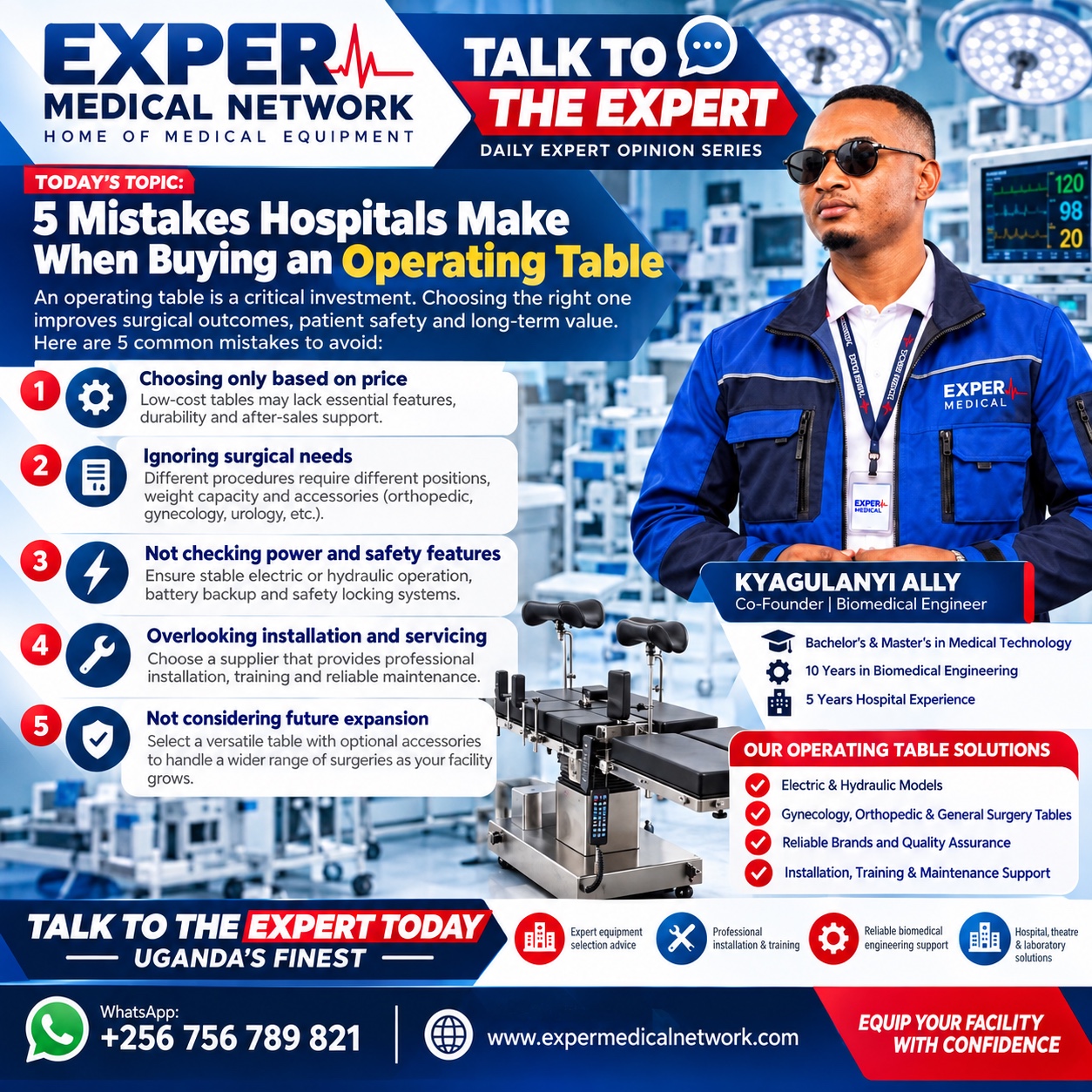
An operating table is one of the most important investments a hospital can make for its surgical department. Whether setting up a new operating theatre or replacing an old surgical table, selecting the right equipment requires more than comparing prices.
A poorly selected operating table may create difficulties with patient positioning, equipment maintenance, surgical access and operating-theatre efficiency.
At Exper Medical Network, we encourage hospitals, clinics and healthcare investors in Uganda, South Sudan and Eastern DRC to consider five important factors before purchasing an operating table.
1. Choosing an Operating Table Based on Price Alone
One of the most common purchasing mistakes is selecting the cheapest available operating table without considering its performance, construction, serviceability and expected operating costs.
A cheaper table may initially look attractive, but missing accessories, difficult repairs or unsuitable specifications can increase the total cost of ownership.
Expert advice: Compare the table’s features, manufacturer’s documentation, warranty, spare-parts availability and after-sales service alongside the purchase price.
2. Ignoring the Hospital’s Surgical Requirements
Operating tables are designed with different functions and capabilities.
A table suitable for basic general surgery may not provide all the positioning capabilities and accessories required for orthopaedic surgery, gynaecology, urology or specialised procedures.
Before purchasing, hospitals should evaluate:
- Required surgical positions, including Trendelenburg, reverse Trendelenburg and lateral tilt.
- Height adjustment and safe working positions.
- Patient weight capacity.
- Radiolucent tabletop sections where imaging is required.
- Availability of appropriate leg supports, arm supports and other accessories.
Expert advice: Consult surgeons, theatre nurses and biomedical engineers before finalising equipment specifications.
3. Failing to Evaluate Power and Safety Features
Operating tables may use manual, hydraulic, electrohydraulic or electric mechanisms.
For electrically powered models, hospitals should check electrical compatibility, battery-backup arrangements where applicable and the manufacturer’s instructions for safe operation.
Mechanical stability, braking systems, patient-support surfaces and emergency operating procedures also deserve careful evaluation.
Expert advice: Request an equipment demonstration and verify all required movements, locking mechanisms, controls and safety functions before clinical use.
4. Overlooking Installation, Training and Maintenance
An operating table should not simply be delivered and immediately placed into clinical service without proper checks.
Hospitals should establish whether their supplier provides the required installation support, acceptance testing, user training and maintenance documentation.
A biomedical engineer should help verify functionality and record the equipment’s baseline condition during commissioning.
Expert advice: Confirm the scope of technical support in writing, including warranty conditions, maintenance responsibilities and the procedure for reporting faults.
5. Buying Without Considering Future Hospital Expansion
Healthcare facilities evolve. A hospital performing only general surgical procedures today may introduce new specialities in the future.
An operating table with suitable modular accessories and adaptable positioning functions may offer greater long-term flexibility.
However, hospitals should avoid paying for unnecessary features that do not match realistic service-development plans.
Expert advice: Choose equipment that meets current clinical requirements while providing sensible opportunities for future expansion.
Which Operating Table Should Your Hospital Choose?
The best operating table is not necessarily the most expensive or the most technologically advanced. It is the model that safely meets your facility’s clinical, technical, operational and financial requirements.
At Exper Medical Network, we help healthcare facilities compare manual, hydraulic and electric operating-table options based on their intended use.
Our team can assist with equipment selection, specifications, quotations and planning for installation, training and maintenance support.
Talk to the Expert — Kyagulanyi Ally
With 10 years of biomedical engineering experience, including five years of hospital experience, Kyagulanyi Ally brings practical technical knowledge to medical equipment selection and healthcare technology management.
His message to hospital administrators:
“When buying medical equipment, don’t ask only how much it costs. Ask whether it meets your clinical needs, how it will be maintained, and whether it will continue serving your hospital reliably.”
Get Professional Operating Table Advice
Planning to equip a new operating theatre or upgrade existing surgical equipment?
Contact Exper Medical Network Ltd — Home of Medical Equipment.
WhatsApp: +256 756 789 821
Website: https://www.expermedicalnetwork.com
Email: info.brandexper@gmail.com
EXPER MEDICAL NETWORK — EQUIP YOUR FACILITY WITH CONFIDENCE.