
A laboratory asks for a replacement “100x lens.” That describes magnification, but not enough to identify a suitable objective. Before approving an order in Uganda, capture the microscope model and the complete markings on the existing objective. A lens that screws into the nosepiece is not automatically the right optical component.
Confirm that replacement is the right next step
Describe the observed problem to the laboratory lead and an appropriate technical person. Is it limited to one objective or present across several? Has the instrument been assessed using the manufacturer’s permitted checks? Do not assume every unclear image means the objective has failed.
Keep the request separate from an unverified diagnosis. Staff should not dismantle optical assemblies or experiment with cleaning chemicals to prove a fault. If assessment is needed, ask for that scope first. It can prevent an unnecessary purchase while preserving the evidence needed to identify the actual issue.
Photograph the information that identifies the optics
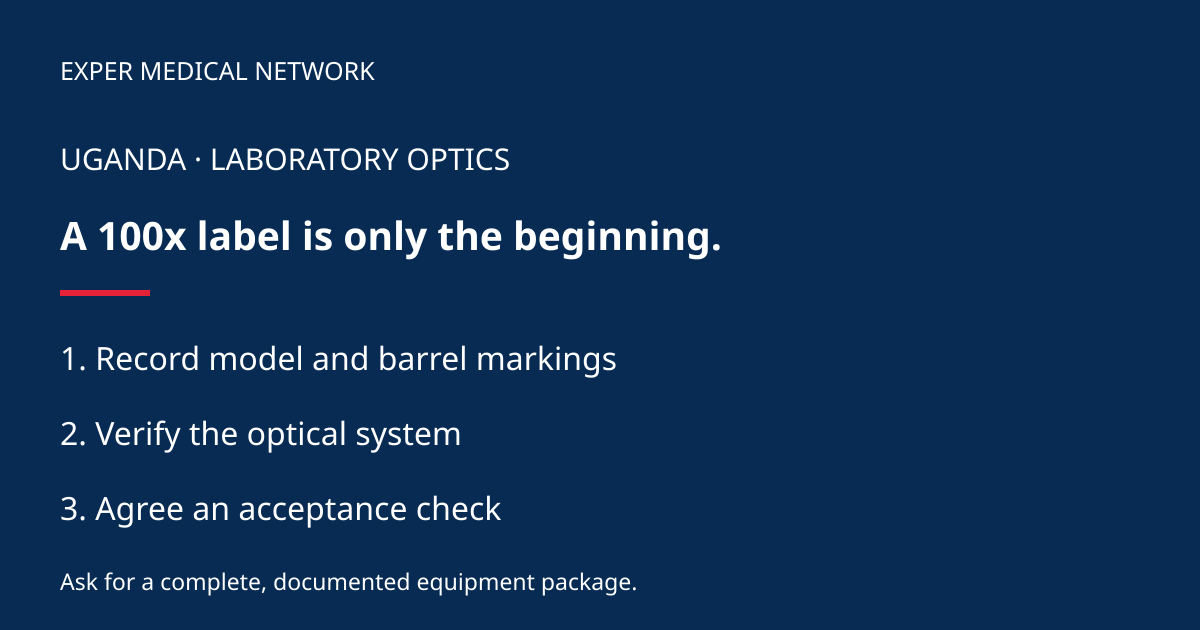
Send the microscope’s model label and clear photographs of the objective barrel. Record magnification, numerical aperture, optical-correction markings, immersion designation and any tube-length or cover-glass information shown. Include the manufacturer’s part reference if available.
Nikon’s MicroscopyU reference explains that objective markings describe several optical properties, and that finite and infinity-corrected designs are not interchangeable. The purchasing implication is simple: magnification alone is not a compatibility specification. Have the proposed objective checked against the instrument documentation rather than selecting it from a generic lens list.
Ask about the complete optical arrangement
Request written confirmation that the proposed objective is suitable for the microscope body and intended observation method. Where relevant, the review should include mechanical fit, parfocal arrangement, condenser and other optical components. Do not infer compatibility between manufacturers from a similar thread or appearance.
For an illustrative case, a laboratory replacing an existing objective and a laboratory adding a new examination method have different requirements. The second may need more than one lens. State whether the goal is like-for-like restoration or a supported upgrade, and ask the laboratory lead to approve the proposed change.
Include care materials and acceptance in the quote
Ask for the handling and cleaning instructions, protective storage and any specified immersion medium. Do not assume supplies used with the previous objective remain suitable. Separate a new component, a used component and a repaired component in the offer, with condition and warranty clearly stated.
Agree how authorised laboratory staff will assess the delivered objective on the actual microscope before routine use. Match the reference and markings, inspect its condition and record the agreed optical checks. A delivery note proves receipt, not suitability for the laboratory’s examinations.
Keep the replacement record for the next enquiry
Update the instrument record with the installed objective reference, supplier documentation and acceptance result. Keep the original configuration identifiable so future staff do not have to reconstruct it from memory. Our maintenance-record guide helps organise this information.
Send Exper your location, microscope model, barrel photographs, problem description and required quantity through the laboratory equipment enquiry page. For complete instruments, see our separate microscope buying guide. Ask whether assessment or a suitable replacement can be supplied; no particular objective or brand availability is implied here.
Technical source reviewed 7 November 2026: Nikon MicroscopyU: microscope objective specifications. Follow the documentation for the actual microscope and objective.
Contact +256 756 789 821 or info.brandexper@gmail.com with your equipment list, quantities and destination. Confirm current availability, delivery charges and written order terms. Payment is 100% before delivery.