
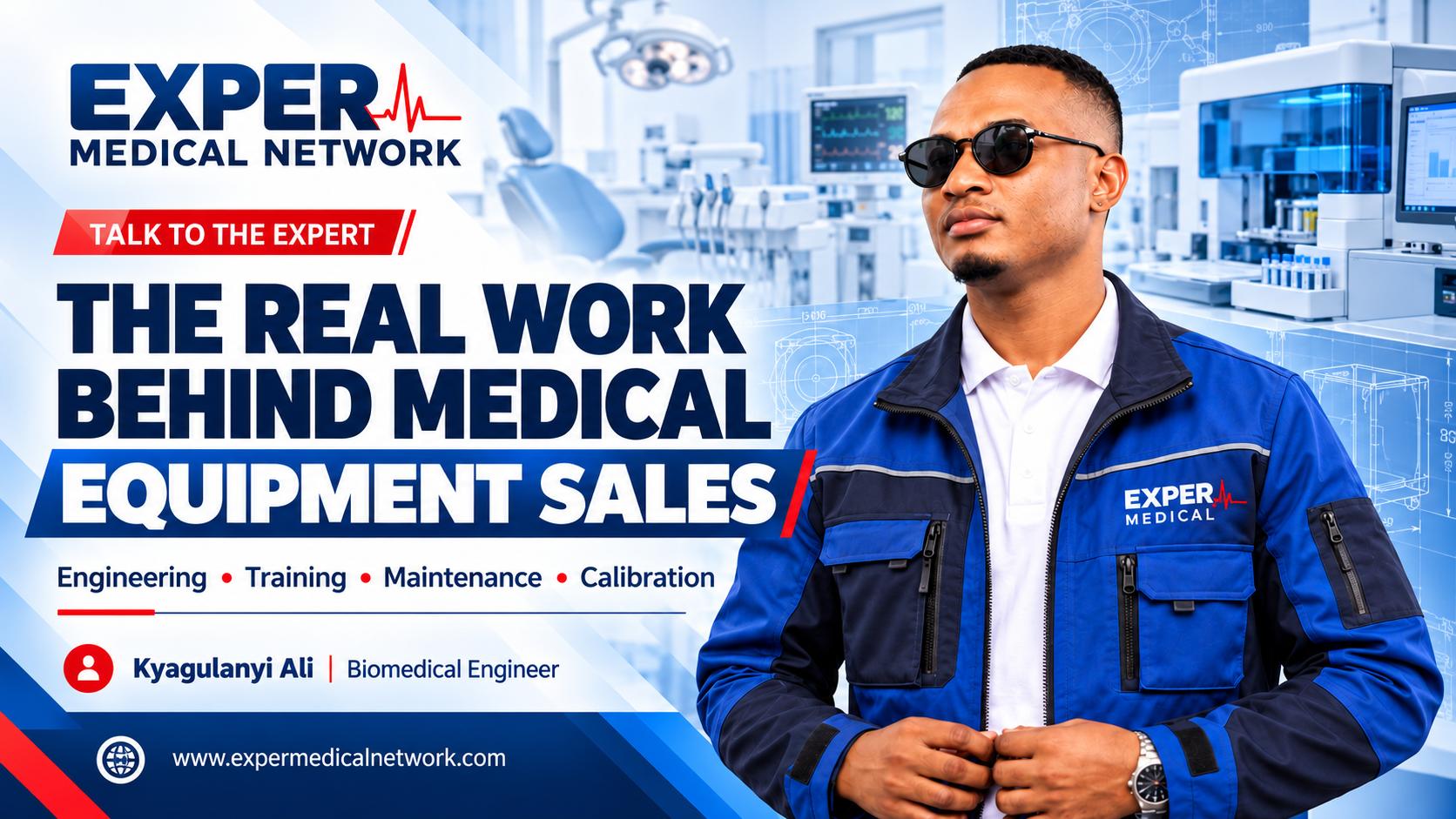
A customer asks, “Ally, what do you sell?”
The short answer is medical equipment.
The fuller answer begins with the questions we ask before recommending a machine: What service are you establishing? Is the room ready? Who will operate it? Who will maintain it?
That probably makes me an inconvenient salesman.
But those questions explain what Exper Medical Network means to me—and why so much of our work happens before and after a sale.
The work you rarely see on an invoice
A considerable part of our day involves explaining, demonstrating, troubleshooting and teaching.
We educate people online, at our premises and inside healthcare facilities. We help users understand their equipment, operate it correctly and recognise when it needs technical attention.
Sometimes, the machine was supplied by a competitor.
We still receive the call because someone needs help. Their immediate concern is finding a person who understands the equipment and can advise them responsibly.
An invoice records a transaction. It rarely captures all the technical work surrounding it.
Before the dental chair comes the drainage question
Imagine a customer ready to buy a dental chair.
The model looks good. The price is acceptable. Everyone is thinking about delivery.
Then we ask about the installation space, water supply, drainage, electricity and any additional requirements for that particular model.
Suddenly, the conversation sounds more like a site meeting than a shopping trip.
Discovering an installation problem before delivery gives the facility time to address it. Discovering it with the chair already at the door is a much less enjoyable experience—for everyone.
For me, that assessment belongs within the purchasing process. Our dental-chair site-readiness checklist helps facilities prepare those questions before ordering.
An X-ray purchase begins before the first image
Choosing an X-ray machine is one part of establishing an imaging service.
The facility must also consider room suitability, shielding, radiation protection and installation requirements, alongside the relevant professional assessments and approvals.
A product photograph and a price cannot answer those questions.
Biomedical engineering connects the equipment to its working environment, the clinical service it must support and the people who will use it.
That connection deserves attention from the beginning. Our X-ray room readiness guide offers a starting point for discussions with the responsible professionals.
A laboratory result needs a foundation of trust
A CBC analyser may fit neatly on a laboratory bench. Establishing reliable operation takes more thought.
The discussion includes compatible reagents, operating conditions, user training, quality control, maintenance and appropriate performance checks.
For a laboratory owner, a useful question is:
“What will we need to operate this analyser reliably, and who will support us?”
The purchase price matters. So do the recurring costs, technical requirements and availability of support throughout the equipment’s working life. When reviewing CBC analyser options, ask for those requirements in writing.
Much of our work starts with a service call
Repair, servicing, preventive maintenance and calibration form a substantial part of our work.
We have undertaken contracts involving these services, and we regularly receive calls about equipment operation, faults and maintenance.
This is the Exper that people may not see from the shop entrance.
We are in the field investigating problems, supporting users, maintaining equipment and helping facilities understand what requires attention.
Some days, the most valuable thing we deliver is a working machine that the customer already owns.
Behind the machine is a clinical service
An unavailable anaesthesia machine can disrupt theatre services. A ventilator failure can affect critical care capacity. An unreliable diagnostic measurement can undermine the information clinicians use.
These consequences shape how I think about our responsibility.
Is the equipment suitable for its intended purpose? Has its performance been appropriately checked? Do its users have the support they need?
We cannot promise that a machine will never fail.
We can take seriously the work of reducing preventable failures, planning maintenance and responding responsibly when problems arise.
The responsibility continues after the delivery note is signed.
Five questions to ask before buying medical equipment
These realities shape how we approach a sale. For buyers, they also provide a practical way to assess the full commitment behind a purchase.
Whether you are opening a clinic, expanding a laboratory or upgrading a hospital department, ask:
- Is this equipment suitable for our workload? Explain the service you intend to provide, expected demand and who will operate the machine.
- What must be ready before installation? Request the model’s site requirements and clarify any assessments or approvals needed.
- What training is included? Establish who will receive training, what it covers and how users can access further assistance.
- What will ongoing operation require? Discuss consumables, accessories, maintenance, spare parts and technical support.
- How will performance be checked? Ask about commissioning, quality control, calibration and other verification appropriate to the equipment.
Get these details documented before committing to the purchase.
They help clarify what your facility must prepare, what the supplier will provide and which responsibilities need further discussion. Our equipment service-agreement checklist can help you record the support arrangements.
The Exper I am building
Sales sustain our business. They pay salaries, support our operations and give us room to grow.
My ambition is to build that business around engineering knowledge, practical education and dependable service.
I want customers to bring us the whole problem: the service they want to establish, the space available, the people who will operate the equipment and the support they will need.
That is why I describe Exper Medical Network as a medical equipment solutions and biomedical engineering company, providing supply, installation, user training, maintenance, repair and calibration services.
It is a longer answer to “What do you sell?” But it reflects the work we do—and the company I want us to keep building.
Planning an equipment purchase or dealing with a machine already in use? Tell us what you need it to do, what you already have and where you need support.
Let us begin with that conversation, whether or not it leads to a sale.
Talk to Exper on WhatsApp · Visit Exper Medical Network
By Kyagulanyi Ali — Biomedical Engineer, Bioinformatician, Co-founder and Director of Exper Medical Network Ltd.