
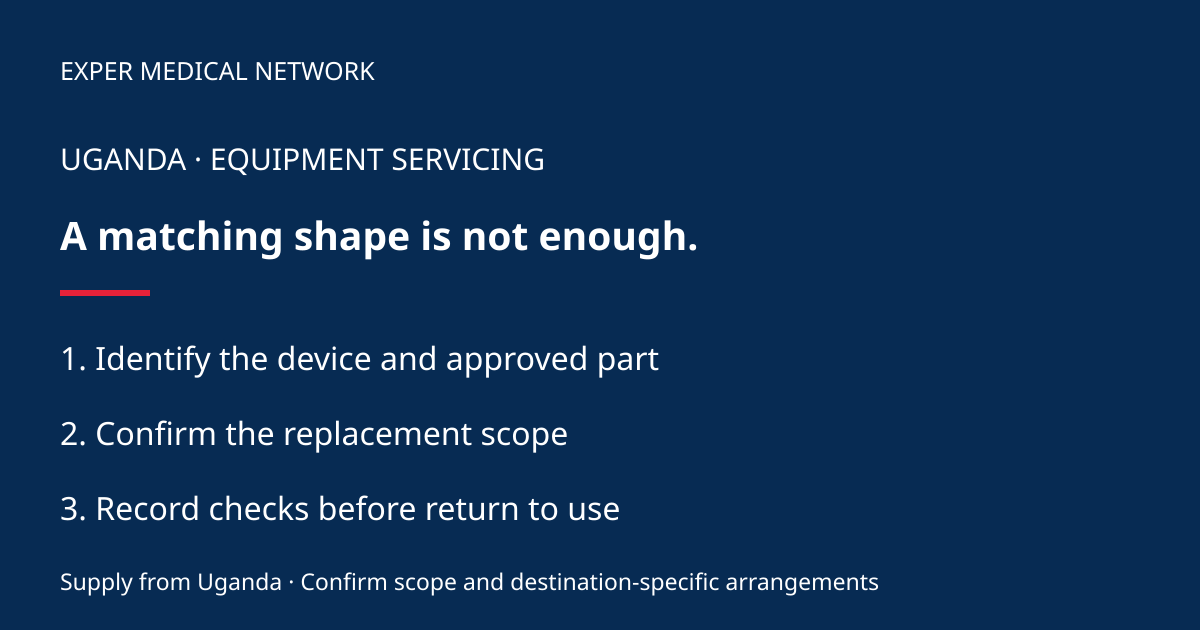
“It fits the compartment” is not enough evidence for a medical-device battery purchase. A Ugandan facility replacing a battery should identify the device and approved replacement reference, then agree who installs it and checks the equipment afterwards.
Start with the device, not an online battery photograph
Collect the manufacturer, model, serial number and asset number. Provide photographs of accessible labels and any existing part reference that can be obtained safely. Ask the biomedical team to consult the applicable documentation; staff should not open equipment just to obtain an enquiry photograph.
State the symptom and the circumstances in which it occurs: charging indication, loss of power, or an error message, for example. Do not assume every short-runtime complaint proves the battery alone is faulty. Request assessment where the cause is uncertain.
Require documented compatibility
Ask the supplier to identify the proposed battery manufacturer, part number and evidence that it is approved for the exact device configuration. Have the technical team review the specified chemistry, electrical characteristics and installation requirements where applicable. A similar connector or advertised capacity is not a substitute for documented suitability.
A concrete safety example comes from the FDA’s CP150 electrocardiograph recall record, posted on 14 April 2025. It reports battery-related fires involving unapproved aftermarket batteries and records Baxter’s instruction to use its approved replacement. This is a model-specific correction, not a claim that every replacement battery is unsafe or that the FDA determines Ugandan procurement rules.
Facilities with the affected equipment should consult the linked correction and manufacturer guidance, rather than treat this general buying article as the complete corrective-action instructions.
Compare the replacement job, not only the part
Ask whether the quotation covers identification, assessment, the approved part, installation and required post-replacement checks. Establish whether the manufacturer permits user replacement or requires qualified service personnel. Do not request improvised pack rebuilding or connector changes as a purchasing shortcut.
For illustration, a part-only quotation and a quotation including assessment and verification may have different totals for good reasons. Put the scopes side by side before deciding that one is expensive. Our quotation comparison guide provides a useful structure.
Agree the handover evidence
Request a service record identifying the equipment, installed part, work performed and checks completed under the relevant instructions. Ask what evidence supports the device’s intended battery operation and whether any unresolved faults remain. Do not accept a universal runtime promise without the applicable test conditions.
Assign responsibility for reviewing the record and approving return to clinical use. Include handling and disposal of the removed battery in the agreed scope, following manufacturer guidance and applicable facility requirements. Keep the replacement information in the equipment maintenance record so the next service enquiry starts with reliable identification.
Send Exper a traceable request
Send the exact Uganda location, device details, accessible label photographs, symptoms and quantity through the Uganda equipment enquiry page. Ask Exper to confirm whether the specified part and support can be arranged. Do not assume stock, a turnaround time or suitability until confirmed for the actual device.
Safety reference reviewed 12 November 2026: FDA CP150 electrocardiograph recall record Z-1560-2025. The article provides procurement questions, not battery repair instructions.
Contact +256 756 789 821 or info.brandexper@gmail.com with your destination, equipment list and quantities. Exper requires 100% payment before delivery. Request current availability and written terms for your order.