
A dry-block heater quotation without the required block can leave a laboratory with a powered instrument and nowhere suitable to put its tubes. For a Ugandan laboratory planning a purchase, start with the method and vessel list—not the largest temperature number in the brochure.
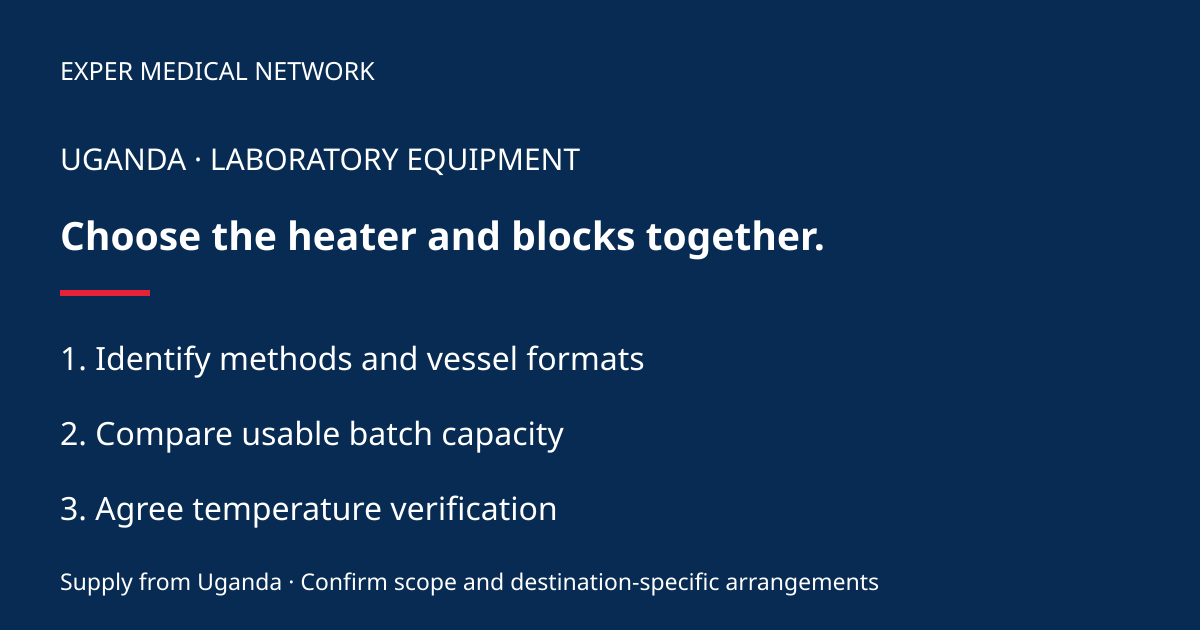
Write down the actual job
Ask the laboratory lead to identify the intended methods, working temperatures, permitted variation and holding times. Record whether heating alone is sufficient or whether cooling or mixing is also required. Do not silently substitute a heating-only unit for a method that needs another function.
List the vessel manufacturer, reference, dimensions and typical working volume. Include tubes, strips or plates actually used by the laboratory. This information gives a supplier something meaningful to assess beyond “small tubes”. Keep the clinical method’s approval separate from an equipment supplier’s catalogue recommendation.
Quote the complete instrument-and-block combination
Request the base instrument and each required block as separate lines, with compatibility confirmed in writing. Eppendorf’s SmartBlock documentation illustrates why this matters: blocks are associated with particular vessel formats and compatible instrument families, and some configurations have specific vessel restrictions. Those examples are not universal specifications for dry-block heaters.
Ask which lids, removal tools or other accessories the offered configuration requires and whether they are included. Avoid improvised inserts or modifications to make a poorly fitting vessel appear usable. Obtain the manufacturer’s documentation for the actual combination under consideration.
Compare usable capacity with the work queue
Count the number of samples that must run together, allowing for the laboratory’s controls and other method requirements. State whether different methods need different temperatures at the same time. A larger block at one temperature does not automatically solve two simultaneous workflows.
As an illustrative purchasing exercise, compare one unit with interchangeable blocks against separate units for concurrent work. Include block changes, staff handling and waiting time in the discussion. Do not invent a throughput figure: use your laboratory’s actual workload and the proposed instrument’s documented operation.
Ask what the temperature claim describes
Request the specified range, accuracy, uniformity and stability, including the conditions under which those figures apply. Ask whether the stated performance concerns the block or a defined sample arrangement. A display setting alone should not become the laboratory’s acceptance evidence.
Have the laboratory and biomedical teams agree a suitable verification method, reference equipment, representative loading conditions and acceptance limits before ordering. The test plan should follow the selected manufacturer’s instructions and the laboratory method. Keep the evidence and decision with the equipment record.
Confirm the bench and the order
Request electrical requirements, bench clearances and care instructions for the actual model. Plan safe handling and storage of blocks using the manufacturer’s guidance. Ask about support, replacement blocks and what happens if performance checks fail after delivery.
Our water-bath guide covers a different temperature-control arrangement; replacing a bath with a block requires a method assessment, not simply a price comparison. Send Exper your Uganda destination, method requirements, vessel references, batch sizes and required blocks through the laboratory equipment page. Ask whether a documented configuration can be sourced and request itemised current terms.
Manufacturer reference reviewed 8 November 2026: Eppendorf SmartBlock compatibility information. This is a specification example, not an Exper stock or brand-representation claim.
Contact +256 756 789 821 or info.brandexper@gmail.com with your destination, equipment list and quantities. Exper requires 100% payment before delivery. Request current availability and written terms for your order.