
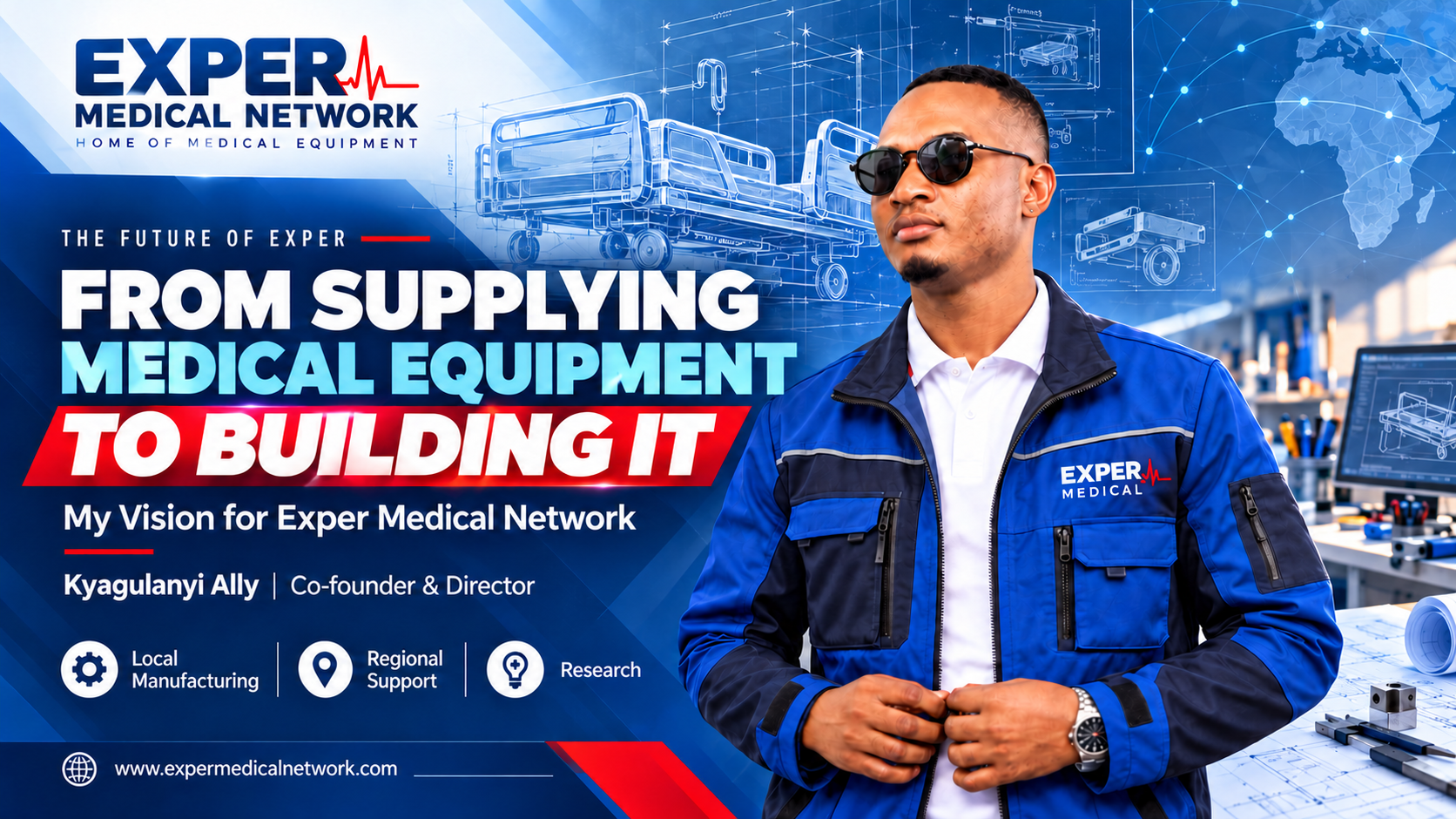
A hospital bed can teach you a surprising amount about the future of a company.
Look closely at its frame, joints, wheels and adjustment mechanisms, and you begin asking questions. Why was it designed this way? How easily can it be repaired? Could we produce something dependable here in Uganda?
Those questions capture where I want Exper Medical Network to go.
We have built our work around medical equipment supply and engineering support. My ambition is to develop that foundation into a business with stronger local production capabilities, dependable regional services and meaningful research partnerships.
It is a big vision. But ambition does not weld a bed frame, validate a diagnostic test or pay a supplier.
The future must be built through work we can demonstrate, decisions we can afford and products people can trust.
What our current work has taught me
Working with healthcare facilities changes how you see equipment.
A buyer may initially ask about the price of a machine. The conversation soon reaches installation, user training, consumables, maintenance and what happens when something fails.
Our work in supply, repair, servicing and calibration brings us close to these practical concerns.
It also shapes my understanding of value. A product must suit its intended purpose, and a facility needs the knowledge and support to keep using it effectively.
That experience is the starting point for my vision of Exper’s future. I explore it further in The Real Work Behind Medical Equipment Sales.
Before we take on new activities, we must strengthen what supports us today: clearer assessments, better documentation, organised service records, practical training and reliable coordination.
Expansion increases the consequences of weak systems. The foundation deserves serious attention.
Why a hospital bed could be our manufacturing starting point
I want Exper to explore local manufacturing through a focused, manageable product.
Hospital beds and examination beds are candidates worth evaluating. They present concrete engineering questions about materials, structural strength, stability, moving parts, surface finishes, cleaning and repair.
A bed looks straightforward until you become responsible for everything that must remain dependable beneath the mattress.
I would like us to explore a prototype pilot around these products, beginning with a defined design and an evaluation plan. This is a proposed direction, not an announcement of completed fabrication, testing or an established production line.
I do not want an attractive sample to be mistaken for a production capability.
A prototype demonstrates a possibility. A dependable product requires a controlled process.
For a bed pilot, that process would need a documented design, defined materials, appropriate inspection and testing, a repeatable production method and a realistic costing.
The questions are practical:
- Can we make consistent units?
- Can we obtain suitable components reliably?
- How will we record faults and design changes?
- What evidence and approvals are required before clinical use?
- Can we maintain and support what we produce?
- Will the selling price cover the full cost?
The answers should determine whether we proceed.
The numbers must work before the workshop grows
Manufacturing can absorb money long before it generates dependable income.
Tools, premises, materials, labour, testing, rejected units and warranty support all require funding. Local production does not automatically mean lower costs, particularly at small volumes.
My preferred approach is staged investment.
Define one pilot. Establish its budget. Evaluate the results. Decide whether the next investment is justified.
For customers, the potential value would need to be tangible: suitable designs, accessible replacement components, practical repair arrangements and dependable support.
Those benefits must be demonstrated. “Made locally” should be the beginning of a quality conversation, rather than its conclusion.
The existing business must also remain able to meet its obligations while we explore new activities.
A project should be allowed to improve, pause or stop. Continuing simply because we have already spent money would be an expensive way to protect our pride.
Regional growth should bring support closer to customers
Uganda remains our base. Our regional ambitions include stronger service capacity in South Sudan and the Democratic Republic of Congo.
For me, a regional presence should make it easier for customers to obtain useful advice, equipment and technical assistance.
That requires more than opening an office.
We must understand demand, operating costs, transport arrangements, local requirements, communication needs and access to competent technicians and spare parts.
A facility purchasing equipment should know how support will work after delivery. Our service-agreement checklist sets out practical questions that help make those arrangements clear.
Regional investment should follow evidence that we can provide that support sustainably. I would rather build a service arrangement that works than announce an office that cannot fulfil its purpose.
Research is a long-term ambition with specific responsibilities
My background in biomedical engineering and bioinformatics makes diagnostic technology particularly interesting to me.
I would like Exper eventually to contribute to research and development involving diagnostic tools, including the possibility of rapid diagnostic tests.
That remains a long-term ambition. We are not announcing an established diagnostic manufacturing capability.
The useful starting point would be a defined problem and an honest assessment of the expertise, infrastructure, resources and oversight needed to investigate it.
Our contribution might begin with practical problem identification, engineering input or data analysis within an appropriately structured collaboration.
The first question is straightforward:
Which problem are we equipped to help solve?
Partnerships should begin with a problem we can define
Equipment work exposes questions that could benefit from research.
Why does a component repeatedly fail? Could a design be easier to maintain? What measurements would help evaluate a proposed improvement?
I would like Exper to develop university and industry partnerships around questions like these.
A useful collaboration needs a defined objective, clear responsibilities, an agreed budget and a way to assess the outcome.
It also needs people who can carry the work forward.
Technicians, fabricators, engineers, researchers and clinical users each bring knowledge that a product team needs. Training and documentation help that knowledge remain useful as the organisation grows.
An ambitious company becomes fragile when essential information lives in one person’s memory—or in a WhatsApp message nobody can find.
Building people and systems belongs alongside building products.
The next step must be specific
I see four priorities guiding this vision:
- Strengthen our current operations: improve supply, installation, training, maintenance and internal coordination.
- Evaluate a focused manufacturing pilot: select a product and assess its performance, production consistency and commercial viability.
- Develop regional support capacity: invest where demand and operational readiness justify it.
- Build research partnerships: pursue defined projects with the necessary expertise and resources.
These activities may overlap, but each investment must have its own justification.
I want progress to be visible in completed work: documented designs, evaluated prototypes, dependable service arrangements and collaborations with clear responsibilities.
The future of Exper should give healthcare facilities stronger reasons to trust us—and give our team greater opportunities to contribute.
For now, the most useful manufacturing conversation is a focused one: what would it take to develop and evaluate a dependable hospital bed that we can produce and support locally?
If you are a fabricator, manufacturing engineer, researcher or healthcare provider with relevant experience, I would welcome that conversation.
Let us begin with a defined problem, a practical plan and work we can stand behind.