
A reclining wheelchair is not automatically an upgrade from a standard chair, and a commode chair is not automatically a daily mobility solution. For a person buying in Uganda, the useful question is: what must this equipment enable the user to do, in their actual home and daily routine?
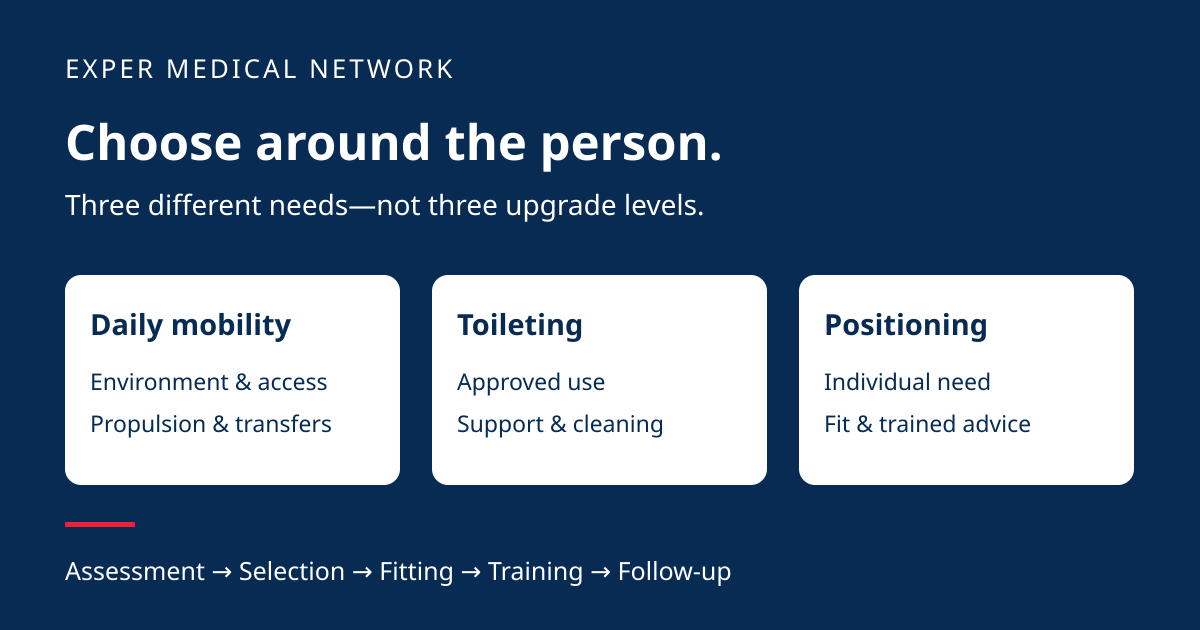
Separate three needs before choosing a product
Everyday mobility: consider where the person will move, whether they will propel themselves or receive assistance, and how transfers will happen. “Standard” is a sales description, not confirmation of fit or suitability for every surface.
Toileting: a commode configuration addresses a different activity. Clarify the intended use, user support and transfer arrangement with a trained assessor. A wheeled commode is not necessarily intended for outdoor mobility, and a commode is not necessarily approved for shower use.
Positioning: a reclining model allows a change in backrest angle, subject to its design. Whether that feature is appropriate depends on the individual. Do not assume it treats a pressure injury, eliminates the need for repositioning or can replace a seating assessment.
Let the person and their environment lead
WHO’s wheelchair provision guidelines recommend an individual process that includes assessment, selection, fitting, training and follow-up. Involve the user and, where appropriate, their carer. Ask a trained wheelchair service professional to assess posture, support, transfer needs and suitable configuration.
Bring practical information: doorway widths, steps, usual surfaces, toilet access, storage and transport arrangements. Confirm manufacturer-rated capacity and dimensions against the assessed requirement. Do not select a seat merely because its advertised width sounds generous; fit needs professional attention.
Ask different questions for each configuration
- Standard wheelchair: is the propulsion arrangement suitable, and can the user manage the proposed environment with the agreed assistance?
- Commode option: what is its approved use, how will toileting and transfers be supported, and how are the relevant parts cleaned according to the instructions?
- Reclining option: why is recline needed, who will operate it and how does the chosen configuration affect transfers, space and transport?
For all three, clarify cushions and supports, brakes, foot supports, replacement parts and user training. Request the exact model documentation. Features shown in a photograph may be optional or belong to another configuration.
One person may have more than one equipment need
As an illustrative example, a person may need daily mobility outside the home and assistance with toileting indoors. That does not establish that one combined chair can safely meet both needs. Ask the assessor to compare a suitable combined arrangement with separate equipment, considering space, transfers and caregiver workload.
Budget discussions should follow that assessment. The cheapest item that cannot be used for the intended activity is not a practical saving. Equally, additional mechanisms are not useful simply because they make the product description longer.
Request an option matched to the assessment
Send Exper the assessed requirements, intended use, delivery town and relevant access or transport constraints through our wheelchair enquiry page. Ask what is included and what fitting or training arrangements are available; do not assume a supply quotation includes clinical assessment. Organisations buying for several people can also read our bulk wheelchair procurement guide.
Technical reference: WHO wheelchair provision guidelines, reviewed 6 November 2026.
Contact +256 756 789 821 or info.brandexper@gmail.com for current options and a written quotation. Exper requires 100% payment before delivery; confirm charges and timing for the specific order.