
“One laryngoscope set” can mean very different contents. Before a hospital in Uganda compares quotations, its airway lead should define exactly which handles and blades the service needs. A well-filled case is not useful if the essential combination is missing.
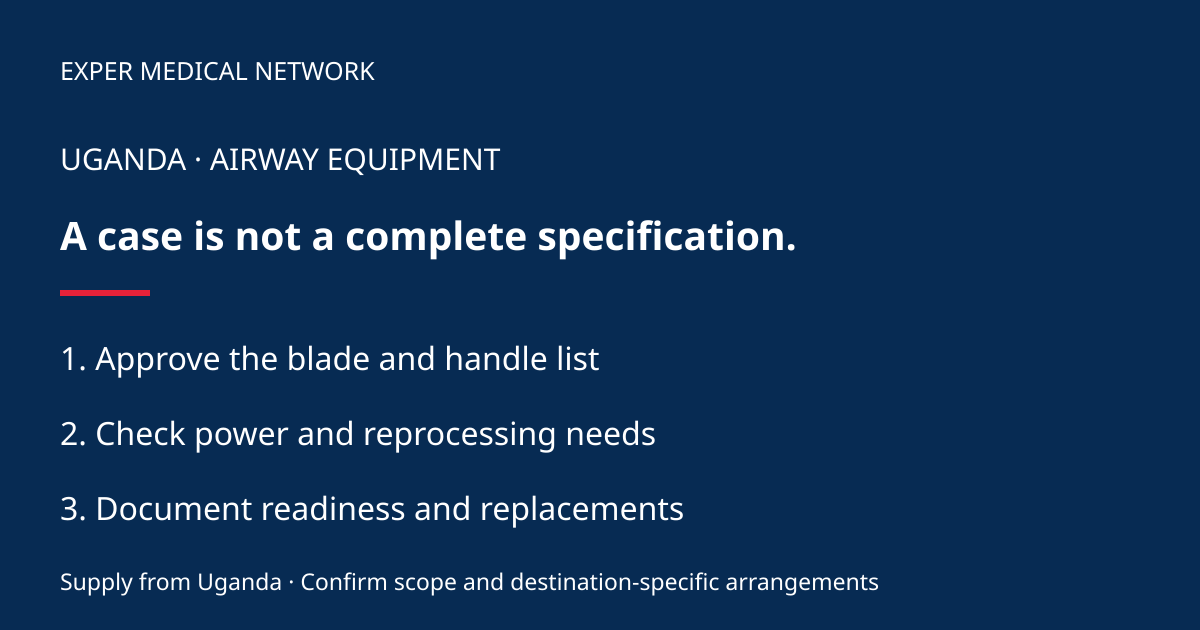
Let the clinical service define the set
Ask the anaesthesia or emergency team to specify the intended clinical setting, patient groups, blade designs and sizes, handle types and quantities. Keep direct-laryngoscopy requirements separate from any video-laryngoscopy request; do not treat the two as interchangeable items in a price comparison.
Procurement staff should translate the approved list into numbered quotation lines. A description such as “adult and paediatric set” needs clarification, not interpretation. Ask suppliers to identify each component by manufacturer and reference, and to mark exclusions or substitutions explicitly.
Verify combinations, not isolated components
Request documentation showing which handles and blades are compatible. HEINE’s EasyClean LED instructions provide a useful model-specific example: they identify a particular blade standard and require compatibility and functionality checks when using another manufacturer’s blades. This does not establish compatibility for every laryngoscope on the market.
For an addition to an existing set, provide the installed handle and blade references. Avoid buying from a photograph alone. Ask the biomedical and clinical teams to agree the receiving checks for the proposed combination before committing to the purchase. The manufacturer example is not a statement that Exper stocks that model.
Include power and the cleaning pathway
List the power arrangement separately: specified batteries, rechargeable components or chargers where applicable. Ask what is included and how replacements are identified. Do not assume a handle described as rechargeable arrives with every charging component.
Obtain model-specific reprocessing instructions for reusable handles and blades and have the infection-prevention team review them. Confirm that the facility can perform the required process. Do not infer that every part can undergo the same cleaning or sterilization cycle. Identify single-use components clearly and plan their replenishment separately.
Plan readiness beyond the delivery date
Have the clinical lead define the required backup arrangement, storage and routine checking responsibilities. HEINE’s example instructions call for function checks before use and recommend a ready backup for emergencies; the chosen equipment’s own documentation must guide its checks.
For illustration, sharing one handle between several locations may reduce the initial order but create a gap when it is unavailable for reprocessing or replacement. The service should assess that arrangement before buying. Do not let the quantity decision emerge accidentally from the cheapest quotation.
Receive against the approved list
Count every component, match references, inspect condition and record the agreed functional checks. Keep unresolved substitutions out of the accepted set until reviewed. File instructions, warranty terms and the fault-reporting contact with the equipment record.
Our crash-cart planning guide covers the broader trolley and contents list. Browse emergency equipment enquiries and send Exper your clinician-approved schedule, quantities, existing component references and Uganda destination. Request confirmation of availability, compatibility evidence, training and service scope.
Manufacturer reference reviewed 8 November 2026: HEINE EasyClean LED instructions. This article supports purchasing, not intubation technique or clinical training.
Contact +256 756 789 821 or info.brandexper@gmail.com with your destination, equipment list and quantities. Exper requires 100% payment before delivery. Request current availability and written terms for your order.