
A warranty is not a maintenance budget. Even when a repair is covered, a facility may still face excluded accessories, transport responsibilities or a period without the equipment. Before buying medical equipment from Uganda for Juba, put the ownership costs beside the purchase price—not on a list to consider next year.
Separate predictable costs from uncertain events
Start with the manufacturer’s required inspection and maintenance activities, then ask who can carry them out for the proposed model and location. WHO distinguishes preventive maintenance, corrective work and inspection. These are useful planning categories, but the actual tasks and intervals must fit the device and the facility’s programme.
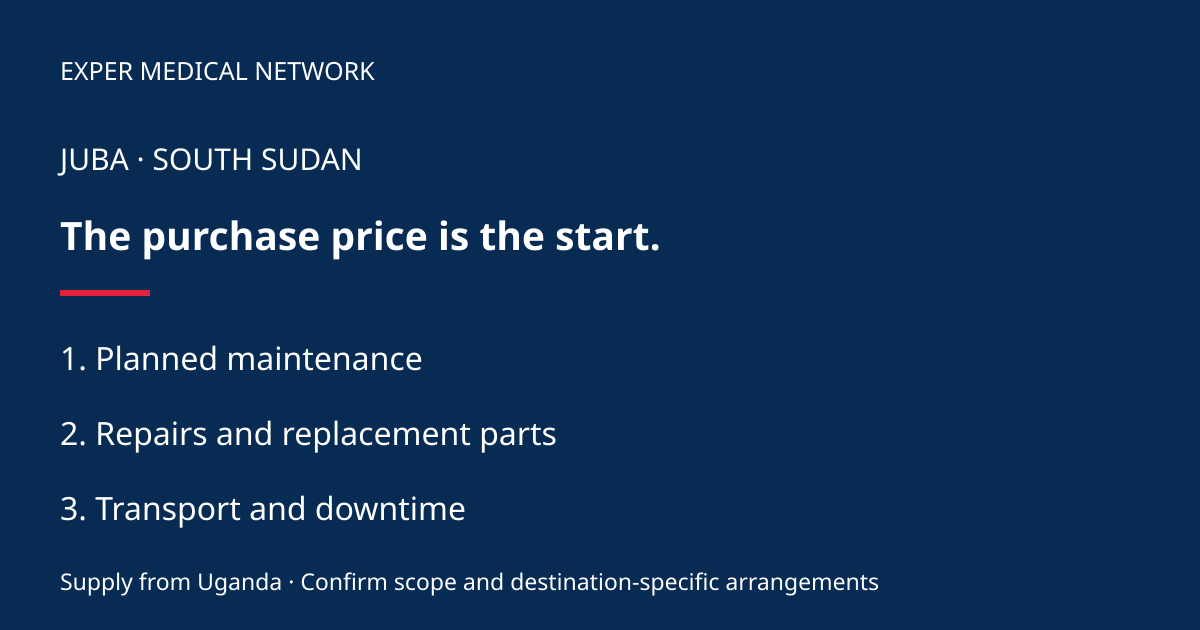
Create three budget headings: planned activities, likely recurring replacements, and a contingency for faults. Do not apply an arbitrary percentage of the purchase price and call the result a verified service cost. Obtain estimates for the model and support arrangement you are considering.
Use a cost sheet that exposes exclusions
- Planned work: scheduled labour, required testing, travel and associated costs where applicable.
- Recurring items: manufacturer-specified replacement items and accessories, with quantities and the basis for replacement.
- Fault response: assessment charges, repair labour, parts, packaging and transport responsibilities.
- Continuity: arrangements approved by the clinical team when the device cannot be used.
Mark each figure as quoted, estimated or unknown. Record its currency and the date it was obtained. If an essential line remains unpriced, show that uncertainty to the purchasing decision-maker rather than treating it as zero.
Test the budget against two support scenarios
Consider one scenario in which the issue can be resolved through an agreed visit and another in which the equipment or a component must return to Kampala. These are planning scenarios, not promises that either service is available. Ask the supplier which arrangements are actually possible before assigning costs.
For each supported scenario, identify who organises packing, custody, transport, documentation and the return checks. Keep an assessment estimate separate from a confirmed repair quotation. A part being obtainable does not establish its arrival date or the date equipment can return to use.
Buy spares for an identified need, not reassurance
Ask for exact part identifiers, compatibility, storage requirements and any limits on shelf life. Discuss which items can appropriately be held by the facility and which require trained service personnel. A box of vaguely labelled “universal spares” may tie up funds without resolving the faults that matter.
Prioritise with the biomedical and clinical teams according to service importance, support arrangements and the consequences of downtime. Do not encourage staff to fit unfamiliar parts simply because they are on the shelf. Keep maintenance and repair records so the next budget uses actual expenditure and unresolved risks.
Connect the budget to the purchase enquiry
Send Exper your Juba destination, equipment list, quantities, preferred models and intended workload. Request the purchase package and available support costs separately. Our service-agreement checklist helps compare the contract once the budget assumptions are clear; our services section provides an enquiry starting point.
Exper Medical Network supplies medical equipment from Uganda to South Sudan and coordinates delivery with reliable transport companies. Use our South Sudan hub to discuss the destination-specific arrangement. Confirm charges, delivery timing, route, handling and documentation for the actual order. Equipment delivery and repair-return logistics are separate scopes; neither implies a local Exper workshop in Juba.
Reference: WHO medical equipment maintenance programme overview, reviewed 6 November 2026.
Contact +256 756 789 821 or info.brandexper@gmail.com with your destination, equipment list and quantities. Exper requires 100% payment before delivery. Request current availability and written terms for your order.