
A shipment can be complete while an individual department still lacks what it needs. A monitor reaches one room, its mounting parts another, and the manual stays in the purchasing office. For a Juba facility ordering several equipment packages from Uganda, allocation should be agreed before dispatch.
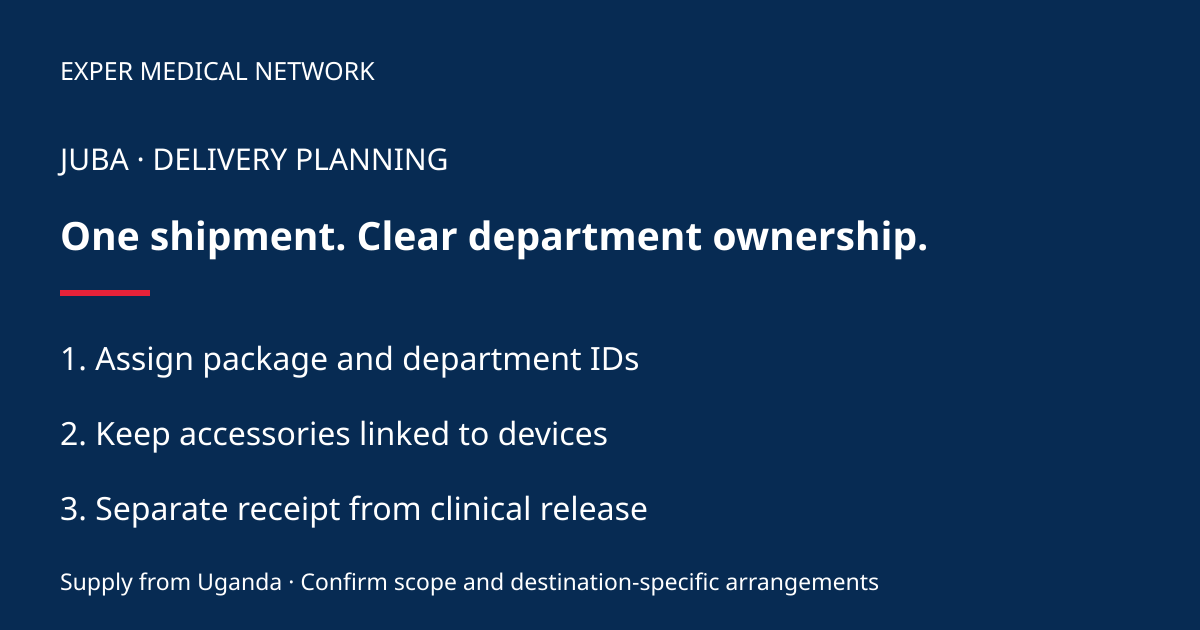
Use one master list with department ownership
Give each ordered package an identifier and name its destination department. List the main device, accessories, consumables and documents underneath that identifier. Keep quantities and approved model references visible, including items supplied separately.
This is not an invitation to rename manufacturer serial numbers. Preserve original product identification and use your facility’s allocation code alongside it. Where serial numbers are not known at quotation stage, leave them pending and capture them when confirmed.
Decide how shared equipment will be assigned
Distinguish permanently allocated devices from items intended to move between departments. Nominate a responsible person for each shared asset and decide where its accessories and records will be kept. Ask users to approve that arrangement before purchasing quantities.
As an illustrative scenario, two departments may both assume that the single quoted trolley belongs to their equipment package. The purchasing total can be correct while the operating plan remains impossible. Resolve ownership on the list rather than after the delivery vehicle has left.
Agree the packing-list structure
Ask the supplier whether cartons can be identified by package and department. Request a record linking separately packed accessories to the parent equipment. Confirm any handling requirements and whether original protective packaging must remain intact until installation.
Do not request labels containing patient information or unnecessary personal details. Department, facility and package references are usually the relevant operational identifiers. If part of the order is unavailable, record the missing lines and agree whether any partial shipment is authorised.
Separate receiving, installation and release
WHO’s health-technology management guidance places incoming inspection, inventory, user training and maintenance after procurement and supply. A useful handover therefore distinguishes physical receipt from the checks needed before clinical use.
Designate who counts packages, who inspects equipment, who updates the asset register and who approves use under the facility’s procedures. Record unresolved discrepancies against the package identifier. Do not turn a signature acknowledging cartons into an unintended acceptance of equipment performance.
Our delivery handover checklist covers broader checks. This allocation list adds the department-level detail needed when one order serves several teams.
Confirm the actual Juba delivery arrangement
Exper Medical Network supplies medical equipment from Uganda to South Sudan and coordinates delivery with reliable transport companies. Send the exact destination, equipment list, quantities and proposed department allocation. Clarify whether delivery is to a central receiving point or another agreed location.
Confirm charges, delivery timing, route, handling and documentation for the specific order. Installation, internal distribution and training must be included explicitly if required; they should not be inferred from the word “delivery”. Exper’s team is based in Kampala, not a presumed local Juba office.
Use the South Sudan hub and quotation form. Reference reviewed 12 November 2026: WHO inventory and maintenance management information systems for medical devices. The allocation example is illustrative, not a reported customer event.
Contact +256 756 789 821 or info.brandexper@gmail.com with your destination, equipment list and quantities. Exper requires 100% payment before delivery. Request current availability and written terms for your order.